How humans are not physically created to eat meat

Although
some historians and anthropologists say that man is historically omnivorous,
our anatomical equipment teeth, jaws, and digestive system favors a
fleshless diet. The American Dietetic Association notes that "most of
mankind for most of human history has lived on vegetarian or near-vegetarian
diets."
And
much of the world still lives that way. Even on most industrialized countries,
the love affair with meat is less than a hundred years old. It started with the
refrigerator car and the twentieth-century consumer society. But even with the
twentieth century, man's body hasn't adapted to eating meat. The prominent
Swedish scientist Karl von Linne states, "Man's structure, external and
internal, compared with that of the other animals, shows that fruit and
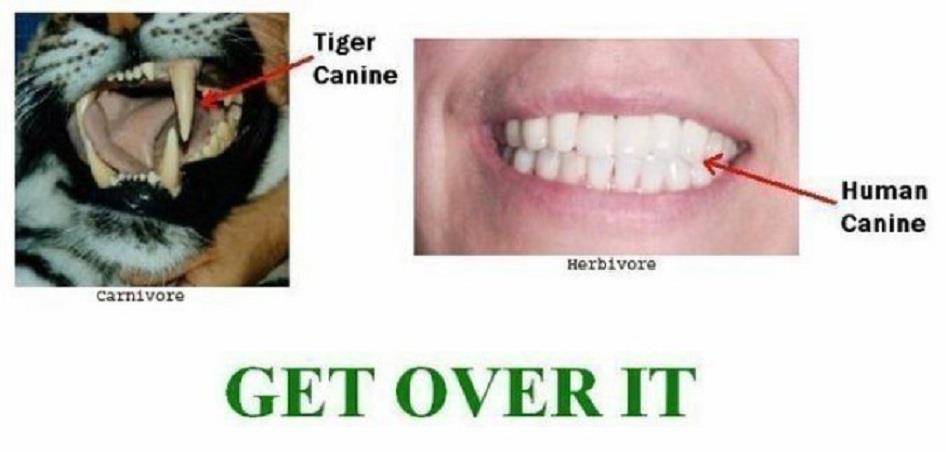
succulent vegetables constitute his natural food." The chart below
compares the anatomy of man with that of carnivorous and herbivorous animals.
When you look at the comparison between herbivores and humans, we compare much more closely to herbivores than meat eating animals. Humans are clearly not designed to digest and ingest meat.
Meat-eaters: have claws
Herbivores: no claws
Humans: no claws
Meat-eaters: have no skin pores and
perspire through the tongue
Herbivores: perspire through skin
pores
Humans: perspire through skin
pores
Meat-eaters: have sharp front teeth for
tearing, with no flat molar teeth for grinding
Herbivores: no sharp front teeth, but
flat rear molars for grinding
Humans: no sharp front teeth, but
flat rear molars for grinding
Meat-eaters: have intestinal tract that
is only 3 times their body length so that rapidly decaying meat can pass
through quickly
Herbivores: have intestinal tract
10-12 times their body length.
Humans: have intestinal tract
10-12 times their body length.
Meat-eaters: have strong hydrochloric
acid in stomach to digest meat
Herbivores: have stomach acid that is
20 times weaker than that of a meat-eater
Humans: have stomach acid that is
20 times weaker than that of a meat-eater
Meat-eaters: salivary glands in mouth
not needed to pre-digest grains and fruits.
Herbivores: well-developed salivary
glands which are necessary to pre-digest grains and fruits
Humans: well-developed salivary
glands, which are necessary to pre-digest, grains and fruits
Meat-eaters: have acid saliva with no
enzyme ptyalin to pre-digest grains
Herbivores: have alkaline saliva with
ptyalin to pre-digest grains
Humans: have alkaline saliva with
ptyalin to pre-digest grains
Based
on a chart by A.D. Andrews, Fit Food for Men, (Chicago: American Hygiene
Society, 1970)
Clearly
if humans were meant to eat meat we wouldn't have so many crucial
ingestive/digestive similarities with animals that are herbivores.
Many
people ask me, "If we weren't supposed to eat meat than why do we?".
It is because we are conditioned to eat meat. Also, the ADA (American Dietetic
Association) tells us that "most of mankind for most of human history has
lived on a vegetarian or Lacto-ovo vegetarian diet."
A
popular statement that meat eaters say is; "In the wild, animals kill
other animals for food. It's a part of nature." First of all, we are not in the
wild. Secondly, we can easily live without eating meat and killing. We all would be healthier this way. Finally, as I have already shown, we weren't
meant to eat meat. Meat putrefies within 4 hours after consumption
and the remnants cling to the walls of the intestines for 14-21 days. If a person is suffering from constipation the rotting meat can stay in the intestines for months or years. Furthermore, the saliva
in humans is more alkaline, whereas in the case of flesh-eating or preying
animals, it is clearly acidic. The alkaline saliva does not act properly on
meat.
The
final point I would like to make on how we as humans were not meant to eat meat
is this; all omnivorous and carnivorous animals eat their meat raw. When a lion
kills an herbivore for food, it tears right into the stomach area to eat the
organs that are filled with blood (nutrients). While eating the stomach, liver,
intestine, etc., the lion laps the blood in the process of eating the dead
animal's flesh. Even bears that are omnivores eat salmon raw. However, eating
raw bloody meat disgust us as humans. This is why we must cook it and season
it to buffer the taste of the flesh.
If
a deer is burned in a forest fire a carnivorous animal will NOT eat its flesh.
Even circus lions have to be feed raw meat so that they will not starve to
death. If humans were truly meant to eat meat then we would eat all of our
meat raw and bloody. The thought of eating such meat makes one’s stomach turn.
This is my point on how we as humans are conditioned to believe that animal
flesh is good for us and that we were meant to consume it for survival and
health purposes. If we are true carnivores or omnivores we would eat animal flesh raw and bloody. Cooking our meat and
seasoning it with salt, ketchup, mayo, mustard or tabasco sauce disguise the awful taste of flesh. This is the only way we as humans would eat meat because we refuse to eat it raw and bloody like real
Overall advantages of vegetarianism
You
can reap a lot of benefits by being a vegetarian and people have become
more aware of the health benefits of being a vegetarian. Animal rights issues
is only one of the reasons why people decide to go on a vegetarian diet. People
are beginning to care more about the environment. However, the main reason why most
people go on vegetarian diet is due to the health benefits.
Meat
is not good for you as it clogs your thinking. This is especially true if you
eat red meat; white meat has less fat compared to red meat. Excessive intake of
fats into your body can result in having a high level of cholesterol. If you
think that not eating meat is going to make you look scrawny or unhealthy
please think again. Just imagine that cows, goats, gorillas, elephants,
rhinoceroses and so on are all vegetarians (herbivores) but look at how tough
these animals are. They also have a longer life span compared to
the carnivores (meat eating animals).
If
you look at the chicken and vulture (carnivores), these animals eat just about
everything and notice how unhealthy these animals look. The Chinese believe
that the chi or life force in your body is less when you consume meat and so do
the Indians with their ancient yogic principles [their life force was called
prana].
The
great Tai Chi masters of China were adept at preserving their chi. Even though some
of the masters were not vegetarians they still had a balanced diet. It has now
been scientifically proven that a balanced vegetarian diet is better compared
to a diet that is taken with meat.
There
are a lot of misconceptions about being a vegetarian; protein is one of the
main topics of debate as a lot of people think that you can only get protein
from meat. Vegetarians get a lot of protein when they eat a variety of fruits,
vegetables, grains and legumes. What vegetarians don't get is the excess
protein of the traditional American diet. This type of diet leads to liver toxicity, kidney overload and
mineral deficiency diseases.
A
lot of people also think that a vegetarian diet is not a balanced diet.
Vegetarian diets have a proportion of three macro nutrients which are complex
carbohydrates, protein and fat. Vegetarian food sources (plants) tend to be
higher sources of most micro nutrients. Another myth that needs to be clarified
is the so-called lack of calcium among vegetarians. Many vegetables especially
green leafy ones have a good supply of calcium. The truth is that vegetarians
suffer less from osteoporosis (a deficiency of calcium that leads to weak
bones).
It
is not my intention to force people to become vegetarians. However,
vegetarianism is my answer to complete health and wellness. The three issues
to consider in regard to vegetarianism are: spiritual, mental and physical
(nutritional).
The
spiritually aspiring person attempts to work on his/her self. The purpose of
spiritual growth is to move away from the  animal nature into the more human
nature that God intended for us to have. Meat eating inhibits this. The
same science that attempts to ignore the existence of a force higher
than man also proved that aggression levels are much
higher in meat eaters than non-meat eaters! The animal instincts become more
powerful every time you eat meat. Another spiritual aspect of being a meat
eater is when one must question the necessity and method of killing animals. However, everyone has their own morals to which they must
determine for themselves. It is not the purpose of my dissertation to force a
specific moral behavior on anyone. Most spiritual people believe in auras.
Kirilian photography shows us that a force field still remains around dead or
amputated flesh. You adopt that animal aura when you eat it's dead flesh. Fruits
and vegetables have a higher vibration al aura than animal products.
animal nature into the more human
nature that God intended for us to have. Meat eating inhibits this. The
same science that attempts to ignore the existence of a force higher
than man also proved that aggression levels are much
higher in meat eaters than non-meat eaters! The animal instincts become more
powerful every time you eat meat. Another spiritual aspect of being a meat
eater is when one must question the necessity and method of killing animals. However, everyone has their own morals to which they must
determine for themselves. It is not the purpose of my dissertation to force a
specific moral behavior on anyone. Most spiritual people believe in auras.
Kirilian photography shows us that a force field still remains around dead or
amputated flesh. You adopt that animal aura when you eat it's dead flesh. Fruits
and vegetables have a higher vibration al aura than animal products.
“You
are what you eat”, is a slogan that I love to use to show the mental aspect of
vegetarianism. When animals are slaughtered, fear and aggression enzymes are
shot into their muscle tissue. They remain in
the meat until the consumer ingests the flesh and adapts the same emotions. Fruits and vegetables do not have
emotions; therefore, when they are picked they do not release any emotional
cells prior to digestion. The enzymes within fruits and vegetables supply the
body with sufficient nutrients that will always uphold a healthy state of mind.
Fruits
and vegetables are high in nutrients; the very thing the body needs to live a
long disease and pain free life. The same cannot be said for meat.
Nutritionally, the alkaline-based digestive system of humans will not properly
break down substantial acid substances of meat.
Colon
cancer is rampant! This is caused by the slow evacuation and putrefaction of meat in the colon. Lifelong vegetarians never suffer from
such an illness. Many meat eaters believe that meat is the sole source of
protein. However, the quality of this protein is so poor that little of it can
ever be utilized by humans. This is due to its incomplete combination of amino acids [the building blocks of protein]. Studies show that the
average American gets five times the amount of protein needed. It is a common
medical fact that excess protein is dangerous. The prime danger of excess meat consumption is uric
acid (the waste product produced in the process of digesting protein). Uric acid attacks
the kidneys and breaks down the kidney cells called nephrons. This condition is
called nephritis; the prime cause of it is overburdening the kidneys. More
usable protein is found in one tablespoon of tofu or soybeans than the average
serving of meat!
Have
you ever seen what happens to a piece of meat that stays in the sun for three
days? Meat can stay in the warmth of the intestine for at least four to five days until
it is digested. It does nothing but wait for passage. Often, it usually stays
there for
Some
vegetarians claim they are more satisfied after they eat. The reason for this
is that there are fewer ketones (protein-digestive substances) formed when
vegetable protein is digested. For many, ketones cause a trace amount of nausea
which one normally interprets as a decreased desire for food due to this
uncomfortable and slight degree of queasiness. Although the body calls for more
food, the taste buds tolerate less. This is the danger of the popular
high-protein diet substances on the market. This abnormally high level of
ketones is called ketosis and refers to the state of starvation that the body
incurs due to the inability of the appetite to call for nutrition. Most
Americans who eat the wrong type
of carbohydrates never recognize the high amount of complex carbohydrates
required to overthrow this condition. Keep in mind that when the blood ketone level are too
high it results in abnormally acidic blood called acidosis.
Tigers
or lions who eat meat have an acid-based digestive systems.
Our Hydrochloric Acid isn’t strong enough to fully digest meat. Also, their
intestines measures about five feet long, not twisted and
turned, layer over layer, compacted into a small area like the human intestine [which is twenty feet long].
Meats
are frozen for a long period of times. Some meats (especially poultry) are frozen
up to two years. Cold temperatures do not kill all species of bacteria. Worse
than this, as it is shipped and stored, most frozen meat is thawed and refrozen
many times. This is almost unavoidable.
Meat
eaters suffer more frequently from various types of food poisoning than
vegetarian. Statistics show that every American has had
food poisoning at least once. When you've felt ill,
had
Meat
is costly and it is the most wasteful source of resources. When one removes
meat from his or her diet a whole new world of eating opens up. Cooking and
preparing vegetarian style is no more time consuming than cooking meat. It
costs less than half as much to eat vegetarian as it does to eat meat. There are
excellent, nutritious, and easy to prepare vegetarian dishes that are Italian,
Chinese, Indian, Mid-Eastern, French, Spanish, etc.
Additionally,
one can enjoy many other foods that he or she has never tasted because of the meat
craze. Most consumers have eaten no more than five or six varieties of beans
and legumes. This is less than 10% of what is available.
In
my opinion, there are far more benefits to becoming a vegetarian then there are
staying a meat eater. Due to the fact that I was raised on meat, I
have experienced both worlds. As a meat eater I was
constantly sick, tired, and overweight. As a vegetarian, I am healthy, full of
energy and maintaining a perfect weight. I love being a vegetarian and it
shows. Because I wish the best for myself, it’s just second nature to want the
best for others. From my past experience and research, going vegetarian is the
best thing anyone can do for their mind, body and spirit.
|
|